
Now Reading: Namo Narayana Ghee Review: Price, Quality & Is It Worth Buying?
-
01
Namo Narayana Ghee Review: Price, Quality & Is It Worth Buying?

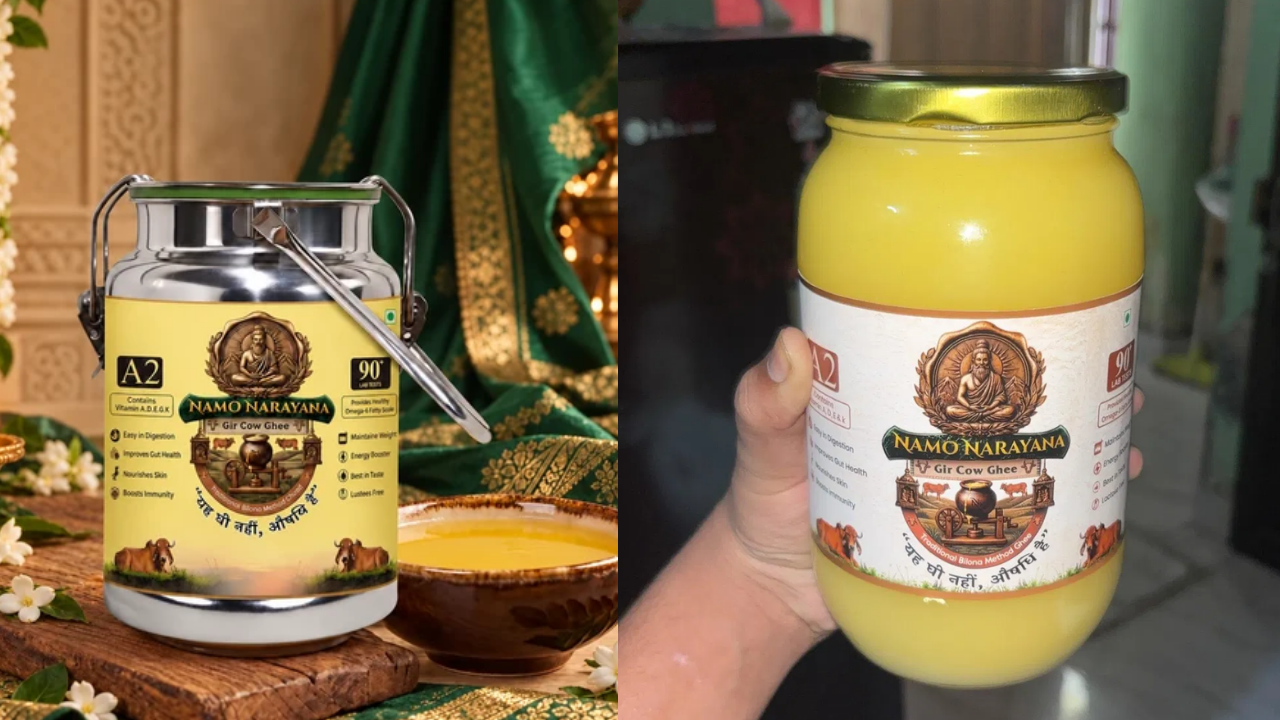
Namo Narayana ghee review is worth reading if you are considering buying premium A2 Gir cow ghee and want to understand its price, manufacturing claims, customer feedback and value for money before placing an order.
Namo Narayana sells ghee marketed as A2 Gir cow ghee made using the traditional Bilona method. Its product page describes the ghee as made from A2 desi cow milk without added preservatives or artificial colours. These are claims made by the brand; they should be distinguished from independently verified laboratory results.
The product is positioned in the premium segment, with its 1-litre pack listed at ₹2,350 on the brand’s website when checked for this review. Smaller and larger packs are also available.
But does the product justify its premium price? To evaluate that, we need to look at the pack sizes, ingredients and manufacturing information, customer reviews, testing transparency and the factors that matter when buying ghee.
Review note: This is a research-based review of publicly available product information. HighDairies has not independently tasted or laboratory-tested this particular product.
Namo Narayana Ghee Price in India
Price is one of the first things buyers should consider when comparing premium ghee brands. The brand’s official product listing showed the following prices at the time of checking. Prices and discounts may change, so confirm the current amount before purchasing.
| Pack Size | Listed Price | Approx. Price per Litre |
|---|---|---|
| 500 ml | ₹1,249 | ₹2,498 |
| 1 litre | ₹2,350 | ₹2,350 |
| 2.5 litres | ₹5,550 | ₹2,220 |
| 5 litres | ₹10,500 | ₹2,100 |
The larger packs offer a lower listed cost per litre. However, buying a bigger jar only makes sense if you regularly use ghee and can store it properly.
The prices above are from the brand’s online listing, not a guarantee of the final checkout price or local retail price. Shipping, available offers and pack availability should be checked before ordering.
Is Namo Narayana Ghee Expensive?
Compared with ordinary household ghee purchases, the listed price places Namo Narayana in the premium category. A higher price may reflect positioning, sourcing, production methods, packaging and distribution costs. However, price alone does not prove superior purity, better nutrition or higher quality. A fair comparison should consider the ingredient declaration, product testing, packaging, traceability and the buyer’s budget—not just the words “A2” or “Bilona” on a product page.
What Is Namo Narayana Ghee Made From?
Namo Narayana describes its product as A2 Gir cow ghee, sourced from indigenous Gir cows in Gujarat. The brand also says it uses the Bilona method and does not add preservatives, artificial colours or other additives. These details help explain how the company positions its product. But when buying any premium food, consumers should distinguish between three things:
- What the brand claims about the product.
- What is declared on the actual package.
- What an appropriate independent test or traceable batch report establishes.
The online product page provides a product description, but the page reviewed did not provide enough batch-specific laboratory data to independently confirm every purity or sourcing claim. Buyers who want additional assurance can ask the company for the latest applicable test report for the batch they intend to purchase.
Also Read:- Is Your Paneer Real or Fake? 5 Simple Home Tests to Check Purity
What Does A2 Gir Cow Ghee Mean?
A2 refers to a type of beta-casein protein associated with the source milk. Gir is an Indian cattle breed. The term “A2 Gir cow ghee” communicates the brand’s stated milk source and product positioning. It does not, by itself, establish that the finished ghee offers superior health outcomes compared with all other ghee.
Ghee is predominantly milk fat, and the product’s actual composition and quality should be evaluated independently of marketing language. If you are buying it for a particular health condition, remember that ghee is a concentrated source of fat. The right amount for you depends on your overall diet and health needs.
What Is the Bilona Method?
The Bilona method is a traditional process associated with making ghee from curd-churned butter. In the process described by Namo Narayana, milk is converted into curd, the curd is churned to obtain butter, and the butter is then heated to produce ghee. The brand says it uses a traditional, bi-directional churning process with a wooden churner.
For buyers, the key question is whether the product’s manufacturing process is clearly documented and consistent with what is advertised. The method may be an important part of a brand’s identity, but the word “Bilona” is not a substitute for quality testing. It does not automatically prove purity, authenticity, nutritional superiority or freedom from adulteration. Consumers should evaluate the manufacturing claim alongside the product label and any relevant test reports.
Namo Narayana Ghee Reviews: What Are Customers Saying?
The brand’s product page displays customer reviews that frequently mention taste, aroma, packaging and perceived quality. On the page checked for this article, the displayed review summary was approximately 90% five-star and 10% four-star. These ratings suggest positive feedback among users who reviewed the product on the brand’s own website. However, they should be interpreted carefully.
What the available reviews indicate
Taste and aroma
Many visible reviewers express satisfaction with the flavour and smell.
Packaging
Some customers praise the presentation and packaging.
Perceived quality
Some reviewers describe the ghee as pure or authentic, based on their personal experience.
Important limitation
Customer opinions cannot independently verify milk sourcing, adulteration status or the product’s laboratory composition.
The reviews are hosted on the brand’s website, so they are not equivalent to an independent consumer survey or laboratory report. Taste and packaging feedback can be helpful, but purity needs stronger evidence than a customer rating.
How Can You Check the Quality of Namo Narayana Ghee?

Before purchasing a premium ghee, look for clear product and quality information.
1. Read the Label
Check the actual container for the product name, ingredient declaration, net quantity, manufacturer or marketer details, batch identification, date information, storage guidance and applicable food licence details. Do not rely only on the brand’s website description.
2. Ask for a Batch-Specific Test Report
If purity is a major reason for choosing a premium product, ask whether a current laboratory report is available for the batch being sold. Review the report’s date, laboratory identity, sample or batch reference and the parameters tested. A report for a different batch may not establish the composition of the jar you receive.
3. Understand What Ghee Standards Mean
FSSAI’s food standards describe ghee as a milk-fat product and set compositional requirements, including a minimum milk-fat level of 99.5% and maximum moisture of 0.5% under the cited standard. Relevant laboratory analysis can assess properties that cannot be confirmed by appearance alone. FSSAI’s dairy testing manual, for example, describes methods for detecting certain vegetable oils in ghee.
4. Check Packaging and Storage
Make sure the container is properly sealed, undamaged and within its labelled date limits. Follow the product’s storage directions after opening. Colour, smell and texture can vary with production and temperature. None of these characteristics by itself proves that the product is pure or adulterated.
Is Namo Narayana Ghee Worth Buying?
The answer depends on what you want from a premium ghee.
| Buyer Priority | What to Consider |
|---|---|
| Premium A2 Gir cow positioning | The brand specifically markets this sourcing claim |
| Traditional Bilona process | The company describes a curd-churning method |
| Price | The 1-litre pack is listed at ₹2,350 on the checked product page |
| Customer feedback | Brand-hosted reviews are generally positive |
| Independent verification | Ask for relevant batch-specific testing if this is important to your decision |
| Budget | Compare the cost per litre with other products you are considering |
Our assessment: Namo Narayana may appeal to buyers specifically looking for premium-positioned A2 Gir cow ghee and traditional Bilona production. Its price is high enough that checking the label and available quality documentation is sensible.
However, the publicly available information reviewed here is not sufficient to conclude that it is purer, healthier or better tasting than competing ghee brands. That would require comparable testing and, for taste, a properly conducted product comparison.
Where Can You Buy Namo Narayana Ghee?
The brand lists its ghee packs on its official website. For the latest available sizes and prices, check the Namo Narayana 1-litre ghee product page. Before ordering, verify the current price, pack size, delivery terms, label details and available testing documents. This is particularly important for an expensive food product purchased online.
Frequently Asked Questions
What is the price of Namo Narayana ghee?
The brand’s website listed the 500 ml pack at ₹1,249, the 1-litre pack at ₹2,350, the 2.5-litre pack at ₹5,550 and the 5-litre pack at ₹10,500 when checked for this review. Prices may change.
Is Namo Narayana ghee made using the Bilona method?
Yes. The brand says it uses the traditional Bilona method involving curd churning to obtain butter, which is then heated to make ghee. This is a brand-stated manufacturing claim.
Is Namo Narayana ghee pure?
The brand markets it as pure A2 Gir cow ghee. However, this review has not independently tested the product. Buyers seeking additional assurance should check the package and request relevant laboratory documentation.
Are Namo Narayana customer reviews positive?
The brand’s own product page displays predominantly positive customer ratings and comments about taste, aroma and packaging. These opinions are useful as customer feedback but cannot independently establish purity.
Is A2 ghee healthier than regular ghee?
The A2 label alone does not prove that the finished ghee produces better health outcomes. Ghee is concentrated fat, so serving size and overall dietary needs matter.
Should you buy the 5-litre pack to save money?
The listed 5-litre pack has a lower price per litre than the smaller packs. It makes financial sense only if you use that quantity, the current price is favourable and you can store it according to the product instructions.
Namo Narayana Ghee Review
Namo Narayana ghee review: the product is positioned as a premium A2 Gir cow ghee made using the traditional Bilona method, with a 1-litre pack listed at ₹2,350 on the brand’s website at the time checked. Its own customer reviews are largely positive, especially regarding taste, aroma and packaging.
The main consideration is value for money. The premium price makes it worthwhile to check the actual label, sourcing information and any relevant batch-specific test report rather than relying solely on the brand’s claims or customer testimonials.
For buyers who prioritise A2 Gir cow sourcing and traditional production, it may be an option to consider. For those focused primarily on price, comparing cost per litre and quality documentation across brands will help them make a more informed decision.
Our recommendation: Compare the available evidence before paying a premium. Neither a high price nor the words “A2” and “Bilona” alone guarantee superior quality.